
How Arrest Warrants Work in Michigan
A Michigan arrest warrant tells an officer to arrest the person named and return them to the court in the order. That decision is always case-specific. A complaint does not automatically produce a warrant, though. A Michigan judge or magistrate can issue a summons instead, sending the accused a notice to appear, when the governing rule permits that route.
Michigan Arrest Warrants Start With a Complaint
Under MCL 764.1a and MCR 6.102, the process starts with a criminal complaint. The complaint lays out the alleged offense and the facts behind it. A Michigan judge or magistrate then reviews whether the legal basis for process exists. That review is not a trial. Depending on the complaint and the circumstances, the Michigan court can issue a summons directing an appearance, or an arrest warrant authorizing custody and a return to court. Not every Michigan complaint ends in a warrant. The Michigan Judicial Institute's explanation of complaints and process walks through how the court weighs probable cause and chooses between the two.
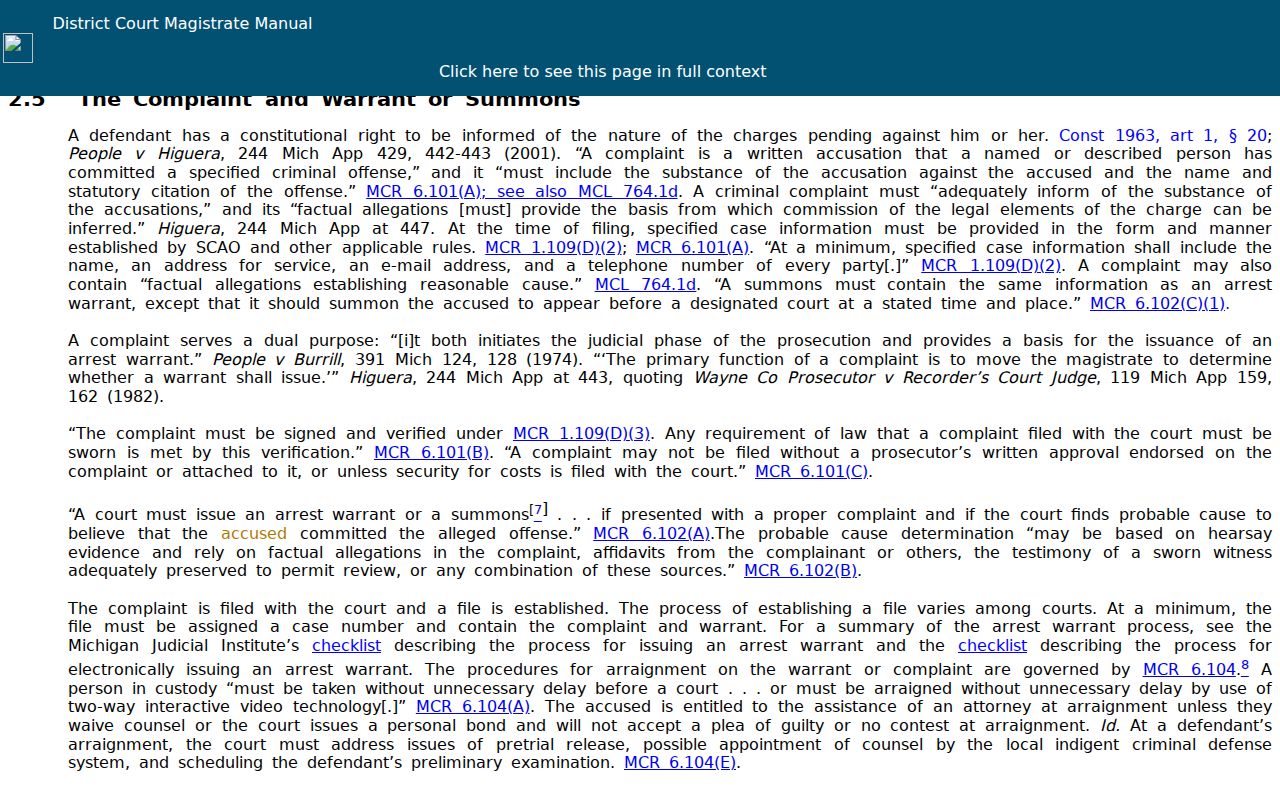
This Michigan benchbook excerpt covers the complaint and process decision. It is legal reference material, not a public warrant list or a status check for any case.
Arrest Warrants: What They Contain
A Michigan arrest-warrant order identifies the court's direction and the case it concerns. Exactly what shows up varies by court and by what is public. A case number is not always a separate warrant number. No statewide public form puts every field into one uniform result.
| Michigan case number | Connects the order to a Michigan court case; it may differ from a locally used warrant number. |
|---|---|
| Michigan named person | Identifies the accused in the Michigan case, but a name match alone does not prove identity. |
| Michigan charge or offense | Names the alleged offense in the Michigan complaint; a charge is not a conviction. |
| Issuing court | Shows which Michigan court holds the underlying record and judicial instructions. |
| Issue date and command | Shows when the Michigan order was signed and what it directs an officer to do. |
| Interim bail | A Michigan court may state a release condition when authorized; ask whether it is current. |
A local Michigan online record can drop a field or use a short label. Ask the issuing court whether the order is active, recalled, served, or superseded, and which identifier it needs to find the file. One court's case number tells you nothing about a statewide format.
Michigan Arrest Warrant Search Limits
Michigan offers no public all-county arrest-warrant search. The Michigan State Police runs the Law Enforcement Information Network, known as LEIN, for authorized users only. It is an operational law-enforcement system, so the public cannot query it, and its help desk for system users is not a personal warrant-check line. The public can use Michigan's MiCOURT Case Search to pick a participating court and search by party name or case number, but that finds a docket, not warrant status. MSP's Michigan ICHAT service searches eligible public criminal-history records and expressly excludes warrants, along with traffic, juvenile, federal, tribal, local-misdemeanor, and suppressed material. So a blank Michigan result, or a missing local listing, proves nothing about whether a warrant exists; ask the issuing court for current status. Where reporting law applies, wanted-person information may reach LEIN, but coverage is not universal. MCL 28.256 keeps misdemeanor traffic and municipal-ordinance warrants outside the relevant Public Act 319 reporting sections. That gap is one more reason no restricted index, court docket, or local public list adds up to a complete Michigan roster.
| Michigan channel | What it can do | What it cannot confirm |
|---|---|---|
| MiCOURT | Locate a docket at a participating court | Current warrant status across all courts |
| ICHAT | Search eligible public criminal-history records | Warrant status, which MSP excludes |
| LEIN | Give authorized agencies operational wanted-person data | A public, self-service warrant search |
| Michigan eWarrant | Support phased agency and court exchange where deployed | A public portal or uniform statewide coverage |
Note: A blank result from a Michigan online docket or history service does not confirm current warrant status.
How Warrants Get Served in Michigan
The court issues the Michigan arrest warrant, and an authorized peace officer executes it. Service usually falls to Michigan county sheriffs or local police, and the warrant's court and the serving agency play separate roles. Under MCL 51.221, sheriffs may execute process within their counties. Officers can also encounter a warrant through authorized law-enforcement checks when the person is outside the issuing county. The public has no matching LEIN query. When an arrest happens outside the court's county, authorities arrange the next appearance or transport under the applicable process, and MCR 6.104 generally calls for arraignment without unnecessary delay before the court named in the warrant. Release terms come from the court's order, never a public list. MCL 764.15 also lists when an officer may arrest without a warrant, so a missing public Michigan arrest-warrant result does not mean an arrest could not lawfully happen under another provision.
Michigan Arrest Warrant Service Roles
Several Michigan records can come into play after a warrant issues. Most Michigan criminal cases start in district court. A felony bindover moves the case to circuit court, which can change where the current records sit. The court controls the case and its judicial actions, an officer or sheriff executes process, and the jail records custody. LEIN feeds restricted information to authorized agencies only.
| Record or office | Role | What to confirm |
|---|---|---|
| Michigan issuing court | Creates the case record and controls warrant, bond, and recall orders | Current status and appearance instructions |
| Michigan sheriff or police | May execute and serve the warrant | Service or custody logistics if the court directs |
| Michigan LEIN | Restricted wanted-person information for authorized users | Whether the court has sent the required update |
A Michigan warrant may be served in the county that issued it. It can also surface through an authorized check elsewhere. The public cannot confirm service coverage in advance. Ask the issuing court about the order itself, and turn to the local agency only for the execution details the court directs. Each office holds a different piece. Note: Michigan service, custody, court action, and statewide updates can sit in different records, so confirm each step with its responsible office.
Arrest Warrants, Summonses, and Bench Warrants
Michigan process can do two things. It directs a person to appear, or it authorizes officers to take that person into custody. A summons is not an arrest warrant. A bench warrant is different again. It generally follows a court event after a case is already pending, so knowing which document you face tells you which court instruction to follow, and the Michigan bench warrant lookup covers missed-appearance and recall procedures.
| Michigan process | Michigan Arrest Warrant | Michigan Summons | Michigan Bench Warrant |
|---|---|---|---|
| What it orders | Arrest and appearance before the court | Appear in court at the stated time | Compliance with an order, which may include arrest |
| Basis | Michigan complaint and probable cause under process rules | Complaint and a court-directed appearance | Missed appearance or noncompliance in a pending matter |
| Who issues it | Michigan judge or magistrate | Michigan court process under the governing rule | Michigan judge in the existing case |
| First response | Confirm status and ask the issuing court about appearance | Appear as directed | Contact the court about recall or a new appearance |
In Michigan, the complaint and the judicial process decide. The person may be ordered to appear by summons. Or the case may permit arrest under a warrant, while a later bench warrant concerns a court event in a matter already pending.
Michigan Arrest Warrant Records and Access Limits
A Michigan court docket, a warrant, and an investigative affidavit each follow different access rules. Under MCR 8.119, public trial-court records may be inspected. A statute, court rule, or sealing order can restrict them. Juvenile records sit under separate limits. The authority is MCL 712A.28. After a bindover on or after July 2, 2024, a Michigan district-court record may turn nonpublic there. Circuit-court access then follows that court's record. The 56-day rule in MCL 780.651 covers search-warrant affidavits only. It does not seal every Michigan arrest warrant for 56 days. Michigan court records answer to court rules. An agency-held record can be requested under Michigan FOIA, though a Michigan exemption may allow it to be withheld or redacted.
Key point: A search-warrant affidavit rule does not establish the status or public availability of a separate arrest warrant.
An empty Michigan docket is not the last word. Ask the court about the case and any access limit. A FOIA request to an agency is neither a guaranteed nor an immediate warrant check. The issuing Michigan court still confirms its own order. Note: In Michigan, the search-affidavit rule does not decide whether a separate criminal complaint or arrest-warrant record is public.
Handling an Arrest Warrant in Your Name
Think a Michigan arrest warrant names you? Use a docket search only to find the likely Michigan court. Then contact that court with the case number. Ask whether the warrant is active, whether interim bail is listed, and how to appear or request recall. A lawyer can assess the Michigan case and arrange a court-approved appearance or surrender. The Michigan county directory routes you to the local Michigan court and sheriff offices that hold the record and handle service. Call the Michigan court before you travel. Ask whether it accepts voluntary appearance under MCR 6.105, whether a judicial officer will be available, and what identification or papers to bring. Do not assume paying a Michigan ticket recalled the order. Do not assume a future court date did either. A blank online result says nothing about a Michigan warrant. After a recall, ask the Michigan court two things. How will it notify the serving agency, and how can you verify any separate LEIN update?
Important: An arrest warrant can be executed during law-enforcement contact. Confirm the court's current instructions and consider legal counsel before arranging an appearance or surrender.
Michigan Arrest Warrant Appearance and Recall
After an arrest on a Michigan warrant, MCR 6.104 generally calls for arraignment without unnecessary delay. The person goes before the Michigan court named in the warrant. Transport or appearance arrangements apply if the arrest happened elsewhere. Ask counsel or the Michigan court how the case will proceed and whether release can be raised at that first appearance. Michigan sets no fixed statewide bond schedule for warrants. MCR 6.102 lets a Michigan warrant list interim bail where it is authorized. Interim bail is optional, not automatic. MCR 6.106 governs release at arraignment. The rule leans toward personal recognizance or an unsecured appearance bond unless that would not reasonably assure appearance or protect public safety. A Michigan judge may add conditions or money bail. Reasons get stated on the record. The exact amount, type, payment method, and conditions depend on the order and the case, and some Michigan orders bar release by payment before a judge reviews the matter. Verify any amount with the court or jail first. If the court recalls the warrant after an appearance or a motion, confirm the recall was entered and the serving law-enforcement agency was told. Confirm both with the clerk. Michigan form MC 220 records the court order, the agency contact, and the certificate of LEIN removal. It shows why the two steps differ. Neither step dismisses the underlying charge. The charge stands unless the court disposes of the case separately. Note: The Michigan court order controls interim bail and appearance terms, and a recall does not by itself dispose of the criminal case.