
How Municipal Warrants Work in Michigan
A Michigan municipal warrant is an order a city court issued in a case it handles itself. Missed appearances often trigger it. So can other failures to comply, though the exact path depends on the case and the judge's order. The issuing court keeps the file. It alone decides whether the warrant is active, whether bond applies, and what action clears it. That is why a Michigan warrant from this tier needs a city-court check even where a countywide lookup exists. These municipal courts sit alongside the district, circuit, and probate tiers that carry most of the state's work. Read the citation or notice for the city and court named there. Then confirm current case status with that court before acting on anything else.
Michigan Has Four Municipal Courts
Only four municipal courts remain in Michigan: Grosse Pointe City, Grosse Pointe Farms, Grosse Pointe Park, and Grosse Pointe Woods. All four sit in Wayne County. The Grosse Pointe Farms court also serves Grosse Pointe Shores. The 2025 State Court Administrative Office judicial-resources report describes this small tier; most former municipal courts became district courts over time. That concentration shapes how you route a question. A notice from one of these courts points to a specific municipal clerk and a local procedure, not to a general docket. Someone who has moved away should still contact the court on the notice rather than assume a new home county holds the file. Each of the four is one example of Michigan's remaining municipal tier, not a template that makes one city's hours, payment options, or online tools the rule statewide. The SCAO Judicial Resources report documents the structure itself. Those court counts describe the system, not any count of open warrants.
Municipal vs County Warrants in Michigan
What matters is which court issued the order and who keeps the record. A Michigan city-court warrant stays under that court's case authority. A county search can help for warrants a sheriff or district court handles, but its reach does not automatically cover a municipal docket. A public court or sheriff list may also be partial. The issuing clerk remains the direct source for warrant status and next steps.
| Question | Municipal Court Warrant | Other County-Court Warrant |
|---|---|---|
| Issuing authority | The municipal court named on the local case | A district, circuit, or other court with jurisdiction |
| Case record | The issuing city court’s docket and clerk | The issuing court’s docket; service records may also sit with police or sheriff |
| Public search | Local contact or lookup varies by court | Some courts or counties publish limited search tools |
| Confirmation | Ask the municipal clerk about status and process | Confirm with the issuing court and, for service, the relevant agency |
Michigan Municipal Warrants May Be Missing Online
Michigan has no public statewide name-searchable warrant database, and no universal municipal-court search form exists. The Michigan State Police LEIN is restricted criminal-justice infrastructure, closed to public lookup. Its Public Act 319 summary lists municipal-ordinance and misdemeanor-traffic warrants as exclusions from relevant reporting sections. That statutory limit explains why a Michigan municipal warrant should not be expected on every statewide or county-facing list. Other online tools have narrower jobs. MiCOURT searches dockets for participating courts and case types; it is not a complete warrant index. eTix handles payable tickets where a court participates, not every municipal warrant. A blank page can mean the case falls outside the tool's coverage, not that the issuing court holds no order. The MSP summary of Public Act 319 describes the reporting rules and their limits. It offers no public search screen and no county-by-county coverage map.
Michigan Municipal Warrant Checks
Work from the city and court printed on the citation or notice. Ask the clerk or warrant contact whether the case carries an active order, and what will resolve it. The Michigan Trial Court Directory helps you find the right court contacts. The county layer is another route: use the Michigan county directory to reach a county subdomain, then locate the municipal court named on the case. Some city court pages link to case information, but the linked search may be unavailable or may not show warrant status. Treat a docket result as a lead until the court confirms the order itself. Ask how the court wants to be contacted, whether by phone, written request, appointment, or an appearance in person. Do not substitute a neighboring Michigan county sheriff's page for the issuing city court, since the warrant answer sits with the court that issued it.
- Read the city, court, case number, and date on the ticket or notice.
- Check the city court’s official case page if it offers one.
- Contact the clerk or warrant office to verify active status, bond, and appearance steps.
- Ask which police or sheriff agency handles service if that information is needed.
The Grosse Pointe Woods Municipal Court page is one local example of a Michigan court process page with case and contact links. It is court-specific, not a statewide search form.
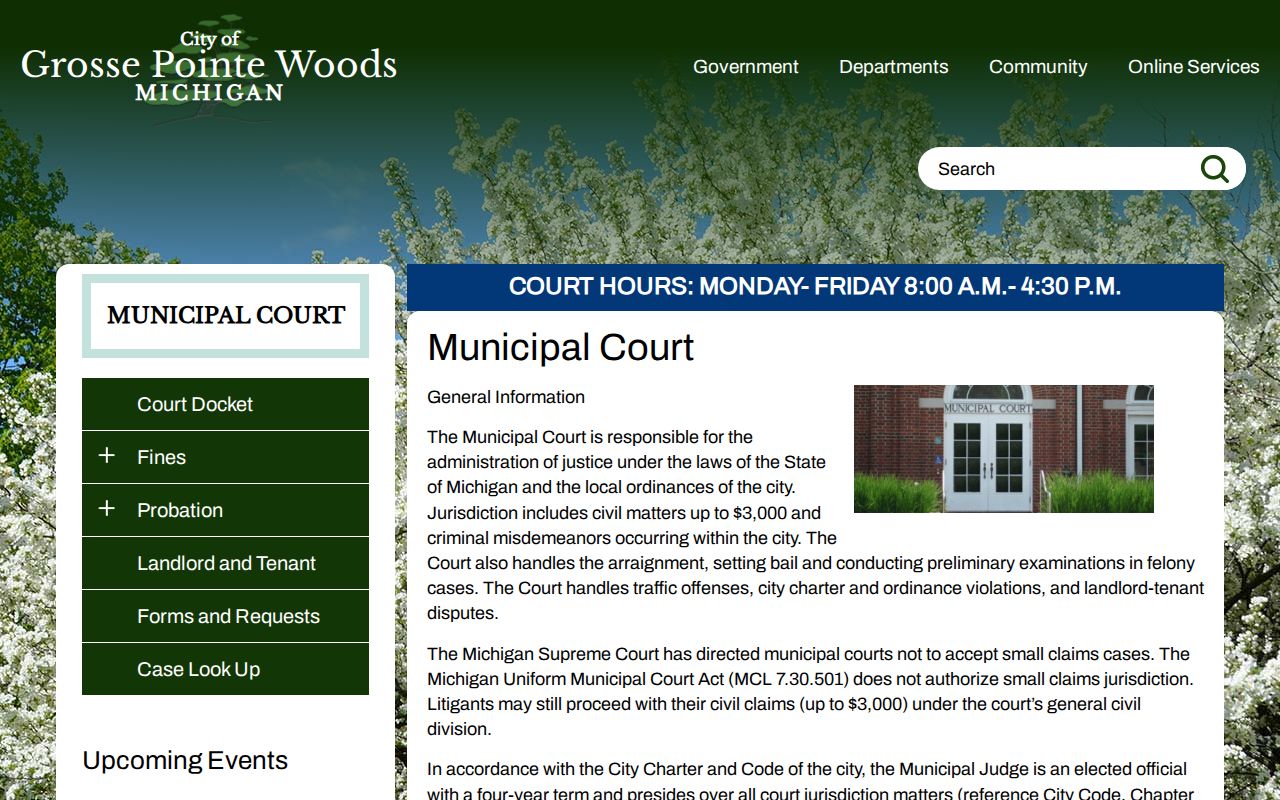
Use the local page to find the court's official route for a Michigan warrant question. Then confirm everything directly with that court.
Michigan Municipal Warrants Have Local Service
In Michigan, two offices split the picture. The municipal judge issues the order and decides when to recall it. City police or another agency may execute it under the court's local process. A county sheriff may serve it or hold custody in a particular case. But a sheriff's office cannot replace the issuing municipal clerk for bond questions, appearance dates, or judicial action. MCL 600.8311 sets municipal-court jurisdiction in Michigan, and local authority shapes how process is handled. Ask the court which agency is responsible before calling elsewhere. If a warrant was recalled, ask whether the Michigan court has notified the agency and what confirmation is available. No one statewide office holds every service record. Note: the issuing court decides case status, while the agency that serves the order answers separate questions about service.
Municipal Warrants: What They Show
A Michigan municipal warrant record can tie one court order to a case number, a charge, and the local court handling it. What follows is a list of things to ask about. It is not a sample record. Every court displays its data differently. Some public pages show docket events only, so ask the clerk whether a warrant field exists and whether the status shown is the official one.
| Warrant number | The local identifier assigned by that court, for example court-assigned number; no statewide municipal format is documented. |
|---|---|
| Case or party | The case number and party name used to match the order to the docket. |
| Charge or ordinance | The alleged offense or local rule connected to the proceeding. |
| Issuing city court | The municipal court with authority over the case and its warrant action. |
| Bond or amount due | Any amount set by the court; ask whether it is bond, fine, cost, or another obligation. |
| Status | Whether the order remains active, was served, or was recalled, as confirmed by the court. |
A posted date never proves an order is still active, so have the clerk confirm the latest court action and any later service update. Michigan municipal case and warrant records are governed by MCR 8.119 plus local court procedures, and the courts sit outside Michigan’s Freedom of Information Act. Inspection of public trial-court records is generally allowed unless a law, rule, or sealing order restricts them, though copies may carry a cost. Public access does not guarantee an online warrant list. Ask the city clerk how to inspect or copy a Michigan court record and whether any field is restricted.
Michigan Municipal Warrants Follow Case Type
A citation from a city tells you little on its own about which process applies. A municipal-ordinance case, a criminal traffic misdemeanor, and a civil infraction can each run under different rules. For misdemeanor traffic failures to appear, MCR 6.615(B) lays out a show-cause path. Civil infractions work differently: a default judgment or license consequence is not automatically an arrest warrant, and MCL 257.744 requires a sworn complaint before any civil-infraction arrest warrant issues. Similarly, MCL 257.321a covers only specified failures in certain traffic matters. It builds a license-suspension process, not a warrant-search system. When a Michigan municipal traffic matter raises both a warrant question and a license question, ask the court and SOS separately. The Michigan traffic warrant reference details those court and license distinctions. Note: The charge category and the court event determine which rule applies, and an overdue ticket alone does not identify a warrant.
Clearing a Michigan Municipal Warrant
Each issuing court decides how its own warrant gets resolved. The route may be an appearance before the judge, a payment, a payment plan, posted bond, or a request to recall. None of that is guaranteed in every municipal case. Call the clerk to learn which event is open and whether payment alone satisfies the court’s order. If you live outside the city, call before traveling. Confirm the right location, the hours, the appearance instructions, and any documents to bring. A family member can help identify the notice and the Michigan court involved, but the clerk may insist on speaking with the person named in the case or on approved authorization before discussing private details. Keep written instructions, and hold on to any receipt once a step is done.
- Confirm the active status, court, case type, and any bond set by the judge.
- Ask whether the next step is an appearance, payment, plan, or motion.
- After complying, ask whether the court entered a recall and notified the serving agency.
Caution: Paying a balance does not prove that a separate warrant was recalled; ask the issuing municipal court what order remains open.
Michigan Municipal Warrants Need Court Recall
Only the issuing court can take the judicial action that recalls or modifies its warrant. Even after a recall, a separate communication with the serving agency or LEIN may still be needed. Michigan’s MC 220 form, Recall of Warrant/Order to Apprehend and Removal from LEIN, shows that court-to-agency process. It is not a public application for removing an entry or checking whether a warrant exists. For a local example, Grosse Pointe Park Municipal Court posts its own contact instructions, but its procedures set no rules for other Michigan municipal courts.
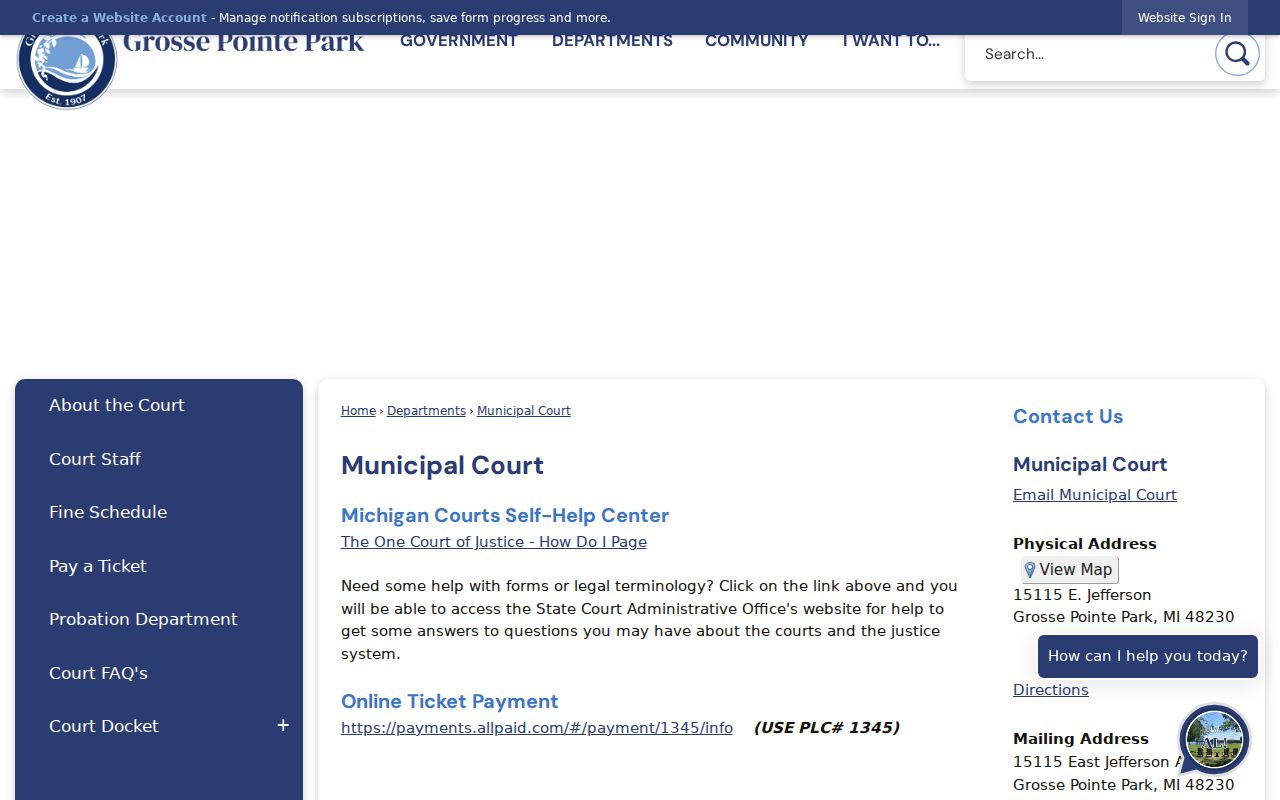
Verify a recall through the Michigan court’s current contact path, then ask whether the agency update is complete.
- Recall
- A court action that withdraws or changes its warrant order.
- LEIN removal
- An operational update after a court recall when an entry was made in the restricted law-enforcement network.
- Capias
- A term used in some court contexts, but not a universal Michigan label for an unpaid ticket or municipal warrant.
Note: In Michigan, court recall and agency-system updates are distinct steps, and no universal posting time is published.