
How Michigan Runs Its Most Wanted List
Michigan State Police calls its public tip route “Michigan’s Most Wanted.” The official Michigan page sends people to law-enforcement and Crime Stoppers channels. It offers no statewide Michigan roster with search fields. No case details appear. Nothing on the page promises a complete list. A tip page and a court docket do different jobs. Michigan tips go to investigators, who can act on what callers report, but the page cannot tell anyone whether a Michigan court holds an active warrant in a case. The Michigan Department of Corrections runs a separate Most Wanted view inside its Offender Tracking Information System. That is a corrections program, not a roll-up of county court warrants in Michigan. For the state police route, start with the official tip-line page.
Michigan State Police Tip Lines
The Michigan State Police page includes its “Michigan’s Most Wanted” tip line. It is a report channel, not a public Michigan warrant lookup.
Michigan Warrants Have Tips, Not a Statewide Roster
Michigan sets up no public statewide search for active warrants. LEIN stays closed to anyone outside authorized criminal-justice work. The public “Michigan’s Most Wanted” entry point is not a case list either. Crime Stoppers of Michigan runs another tip channel. MSP lists its number as 1-800-773-2587. The “Michigan’s Most Wanted” tip line is 1-877-445-8477. Neither number reaches a court clerk or a personal warrant-status desk. Any curated Michigan program features only the cases picked for it, so it will not show every arrest warrant, bench warrant, or traffic matter across Michigan. Someone checking personal status should call the Michigan court named on the citation or notice. The right trial court can also be located through the Michigan Trial Court Directory. That court confirms the Michigan case; an online tip page does not.
Michigan LEIN Is a Restricted Warrant Index
Michigan’s statewide law-enforcement index is LEIN. The Michigan State Police Criminal Justice Information Center administers it. Access goes only to criminal-justice agencies and other statutorily authorized agencies. The public cannot use LEIN for a name search. That limit is why a tip page and a law-enforcement index should not be blended into one “most wanted” database. Michigan Public Act 319 sets reporting rules for specified wanted-person information. It is not a universal all-warrant posting rule. The Act excludes some matters. Misdemeanor traffic cases and city, village, or township ordinance violations stay outside the relevant reporting provisions. The MSP LEIN description spells out the Michigan authorized-user role. For a personal case, the issuing court remains the route.
Statewide or County Most Wanted in Michigan
Michigan’s public offerings sit in separate lanes. The state police tip page routes reports. MDOC’s Most Wanted view covers a corrections population. County sheriffs may publish a local fugitive page if they choose. None of these combine into a complete statewide warrant search, and a county list may omit Michigan matters issued by another court or handled by another agency.
| Feature | Statewide List | County List |
|---|---|---|
| Run By | MSP operates a tip route; MDOC maintains a corrections-focused view. | A county sheriff or local agency, where it publishes one. |
| Who It Covers | Selected tip or corrections program matters, not all court warrants. | A local agency’s selected cases and its own publication scope. |
| What It Does | Routes tips or displays a limited program interface. | May publicize selected local fugitive matters. |
| Where to Start | MSP tip lines or MDOC Most Wanted. | Open the local county site through the county directory. |
Start with the Michigan county directory to reach a sheriff’s or court page. A local agency publishes only what it chooses. That page is not a complete Michigan warrant record.
Michigan MDOC Covers a Defined Population
Michigan’s MDOC Offender Tracking Information System keeps a narrow focus. It tracks people in prison, on parole or probation, plus some for a limited stretch after supervision ends. County jail inmates and city lockup holds stay out of it, so OTIS is never a full Michigan court-warrant source. The agency’s OTIS scope information flags another catch: entries can be incomplete or stale, which means a blank result settles nothing. A separate Michigan MDOC Most Wanted screen can also sit empty at times, and an empty display says nothing about warrants held elsewhere in Michigan. For who the corrections system actually covers, the Michigan MDOC OTIS scope page lays out the population and its limits.
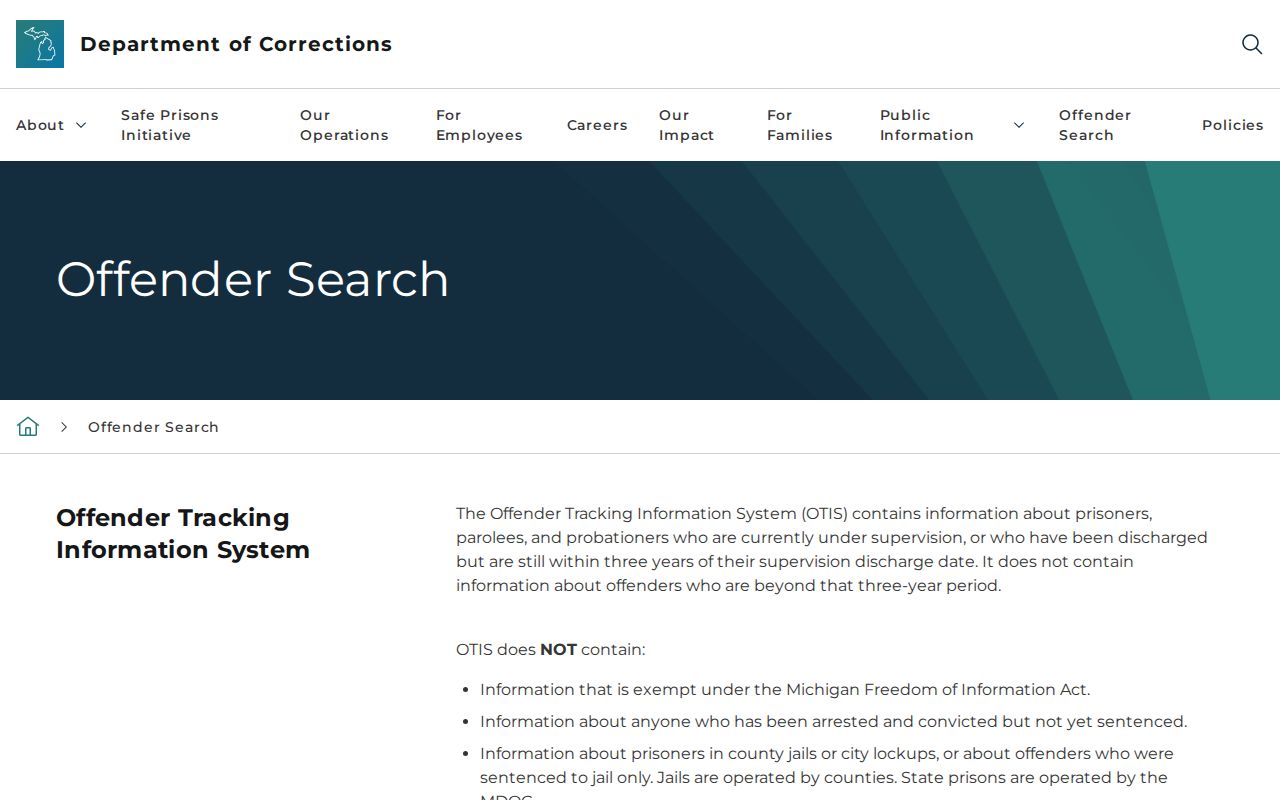
Michigan's OTIS covers only that corrections population, so it can never replace the court that issued the warrant.
Sending a Michigan Tip Safely
Use the channel the agency itself names for its program. Michigan State Police lists a “Michigan’s Most Wanted” number and the Crime Stoppers of Michigan line. Both are tip routes, not search tools. The U.S. Marshals Service posts a separate public tip number for matters its Michigan districts handle. Follow the official instructions for whichever program fits. Each one sets its own reward terms, and none promises every tip stays anonymous.
- Open the official agency page and choose the contact route for the program you mean.
- Share only relevant information through that route, and follow any instructions about anonymity or a reference number.
- For an emergency, use 911. Do not approach or try to detain anyone.
Key point: Send information through an official tip channel and keep a safe distance; a public list is not permission to confront anyone.
The tip-line page lists both Michigan numbers. Call 1-877-445-8477 for “Michigan’s Most Wanted” or 1-800-773-2587 for Crime Stoppers of Michigan.
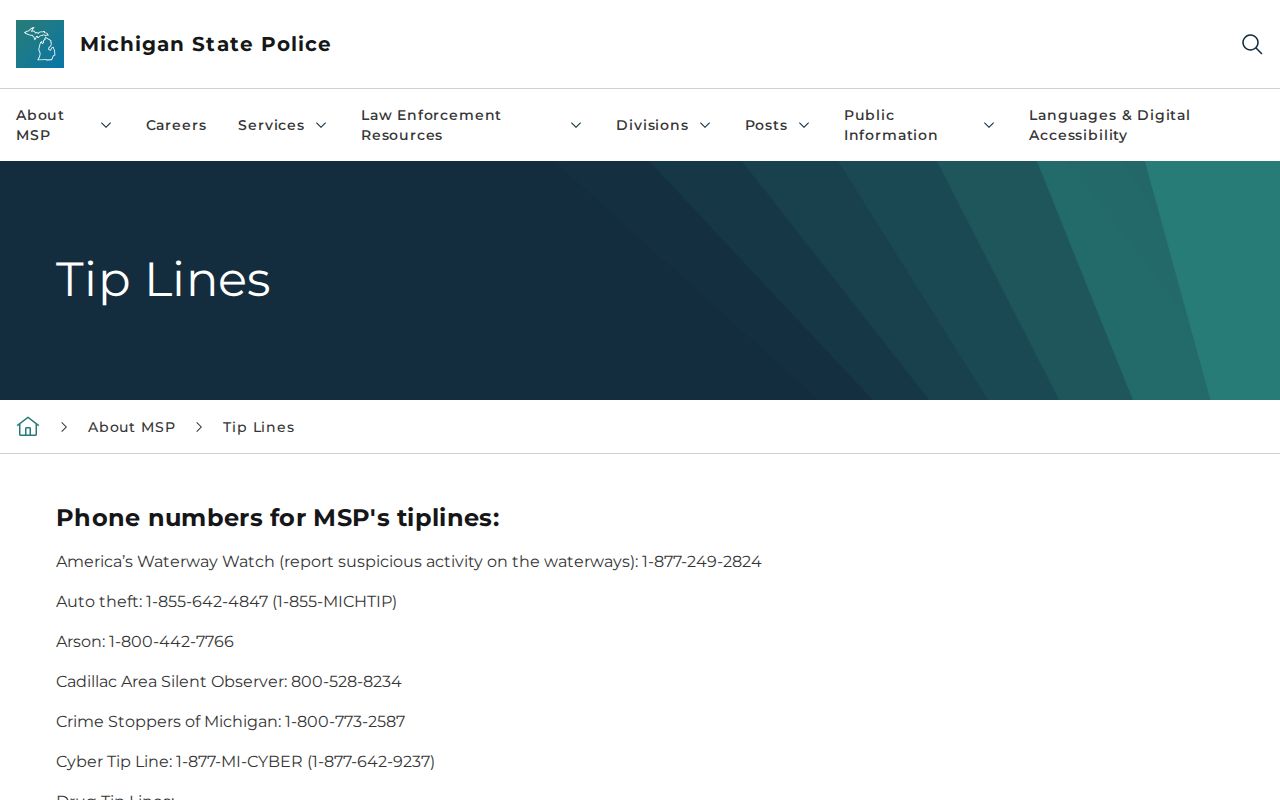
The official Michigan contact page carries the current reporting instructions. It is not a case-status service.
Michigan Warrant Tips and Federal Fugitive Teams
Federal fugitive work in Michigan runs on its own track. The U.S. Marshals Service lists the Detroit Fugitive Apprehension Team and the Grand Rapids Apprehension Team as joint efforts with federal, state, and local partners. Each team takes on selected fugitive matters. They are not a statewide court index. A tip line will not confirm whether someone has a Michigan county warrant, either.
U.S. Marshals, Eastern District
The Eastern Michigan district page describes federal fugitive coordination. It lists the general tip route, not a personal Michigan warrant lookup.
U.S. Marshals, Western District
The Western Michigan district covers the western Lower Peninsula and Upper Peninsula; its program information is distinct from state court records.
The Marshals post a Michigan tip number for these districts: 1-888-869-4589. Use it to pass along information under official instructions, not to seek case details or arrange a personal surrender.
Michigan Most Wanted or Active Warrant
A Michigan most-wanted page is a chosen set of public notices, not the full picture. An active warrant is a court order, and it can stand even when the name never appears on a tip page, a corrections list, or a local sheriff website. The state police tip channel and the MDOC program serve different purposes and cover different populations. So a blank page, an empty search, or a missing name proves nothing about whether a Michigan warrant exists. Michigan also has no public statewide active-warrant search. LEIN is restricted, ICHAT leaves out warrant data, and MiCOURT covers participating court dockets rather than every warrant. For your own case, go to the court named on the paperwork and ask whether the warrant is current. The Michigan Active Warrant Search page lays out the local and court confirmation path.
Michigan Tip Pages Cannot Clear a Warrant
A Michigan tip system moves information to an agency. It cannot recall a court order, set bond, or close a case. Once a warrant is confirmed, the issuing court controls the next judicial step. A separate police or sheriff's agency may handle service and custody, and an authorized system update can follow the court's action. A public roster or a tip phone number can do none of that.
- Most-wanted program
- A selected agency effort that publicizes certain fugitive matters or gathers tips. It is not a complete warrant database.
- Active warrant
- A local or court status suggesting action is still required. Michigan has no single public statewide status glossary.
- Recall
- A court’s withdrawal of its warrant. A separate notice or LEIN removal step may need confirmation.
When the worry is a specific Michigan court obligation, use the court contact route rather than a tip service. For public records held by an executive agency, Michigan FOIA may apply subject to exemptions. Court records follow MCR 8.119 and any restriction that applies.
Finding Your Own Name on a Michigan List
Seeing your own name on a public page is a reason to verify, not to rely on the display. Similar names get confused, and a county or corrections program may not show the court order's current status. Do not call a tip line to ask whether a warrant is active. Instead, contact the issuing court's clerk or talk with a Michigan attorney about confirming the record and arranging the next step.
Important: If a warrant may be yours, ask an attorney or the issuing court to confirm the case and explain the court’s appearance and release procedure.
The Michigan Trial Court Directory helps identify the right court. The county directory offers the next local route to the issuing court or serving sheriff when a matter is county-based. Michigan has no statewide warrant-amnesty week. Local court events carry date and eligibility limits, and an old notice does not mean relief is available now. Ask the court whether any current option fits the specific case before counting on an event listing.