
How Bench Warrants Work in Michigan
A Michigan bench warrant comes from a court already handling a case. Something went wrong there. Usually it is a missed appearance or an ignored order. A skipped arraignment, pretrial, or trial date can lead to one, and so can other failures to comply. The court must act under the rule that fits the case, and the resulting warrant can authorize an arrest. Family-support matters in Michigan can also produce a bench warrant or an order to apprehend after a missed show-cause hearing. For the Friend of the Court contempt warrants it covers, MCL 552.631 sets a cash performance bond of at least $500 or 25% of arrears, whichever is greater, and permits a higher amount within the statute. That narrow family-support rule is not a Michigan-wide bond schedule. An unpaid fine or balance alone does not prove a warrant exists. Ask the Michigan court what order is open, what event caused it, and what action the court requires.
Michigan Bench Warrants and the 48-Hour Rule
Miss an ordinary criminal court date in Michigan, and a bench warrant does not follow instantly. MCR 6.103 generally builds in a 48-hour wait. The Michigan court calendar and its closed-day rules shape the count. The rule also limits bond revocation during that period. But this is not free time. Do not sit on it. Contact the court promptly. Exceptions exist, covering assaultive and domestic-violence cases, a prior failure to appear, and record-supported findings that allow immediate issuance. A Michigan misdemeanor traffic citation takes a separate show-cause route under MCR 6.615(B). A civil infraction can end in default and license procedures without ever becoming an arrest warrant.
| Michigan case path | Michigan rule point | Michigan court question |
|---|---|---|
| Michigan criminal FTA | Michigan's usual 48-hour wait, subject to calendar terms | Is there an order, and what is the next date? |
| Michigan rule exceptions | Michigan exceptions can allow immediate issuance under the rule | What did the judge enter in this case? |
| Michigan misdemeanor traffic | Michigan's separate show-cause process | Is this still show-cause, or did a warrant issue? |
Note: Michigan's 48-hour rule covers ordinary criminal failures to appear and carries its own calendar terms and listed exceptions.
Bench Warrant Issuance in Michigan
No single automatic process turns a missed Michigan hearing into a warrant. Each judge weighs the case event and the governing rule. Then the judge decides. If an order issues, the Michigan court docket records that action. The warrant stays tied to its case. Only the court can recall, quash, or resolve it. After issuance in Michigan, a sheriff or police agency may handle execution. Some wanted-person entries reach the Law Enforcement Information Network. That system is restricted and runs under its own rules. Reporting is not universal, because MCL 28.256 excludes misdemeanor traffic warrants and municipal-ordinance warrants from the relevant Public Act 319 sections. So a Michigan court record and an agency record can answer different questions.
Michigan's District, Circuit, and Probate Warrant Courts
A Michigan bench warrant can come from more than one tier of court. District courts handle most misdemeanors and many traffic cases. Circuit courts take felonies after bindover and family matters. Probate courts address specified juvenile and family cases, and judges issue warrants within their own jurisdiction.
| Michigan court level | Common case context | Record contact |
|---|---|---|
| Michigan district | Misdemeanors, traffic cases, arraignments, felony preliminary exams | Michigan district-court clerk or warrant unit |
| Michigan circuit | Felony cases after bindover and family division matters | Michigan circuit clerk, commonly the county clerk |
| Michigan probate | Probate and specified juvenile or family matters | Michigan probate register |
| Michigan municipal | Local matters in the four courts that remain | The issuing Michigan municipal court |
The State Court Administrative Office's January 1, 2024 table listed 103 district, 57 circuit, 78 probate, and four municipal trial courts in Michigan. Those are court counts, not warrant counts. All four municipal courts sit in Wayne County: Grosse Pointe City, Grosse Pointe Farms, Grosse Pointe Park, and Grosse Pointe Woods. Farms also serves Grosse Pointe Shores. That group is a limited local exception in Michigan, not a statewide municipal-warrant service. A felony can move from district to circuit court after bindover. So the first docket may not stay current. Ask which Michigan court controls the file now, since notices may name a different court after bindover. The SCAO court-count table lists the courts by type and region.
How Bench and Arrest Warrants Differ
Michigan bench and arrest warrants can both direct officers to take a person into custody. Their starting points differ. A bench warrant follows a court event in a case already open. An arrest warrant is different. It starts with a complaint and a judicial probable-cause decision about an alleged offense. For that path, see the Michigan arrest warrant lookup.
| Michigan feature | Michigan Bench Warrant | Michigan Arrest Warrant |
|---|---|---|
| Trigger | Missed Michigan court appearance or failure to comply in a pending matter | Complaint and probable cause for an alleged offense |
| Who Issues It | The judge in the court case | A judge or magistrate under statute and court rule |
| Underlying Michigan case | Existing proceeding continues | Criminal charge proceeds after process issues |
| How Michigan clears it | Issuing court recalls or quashes it after required action | Court action, appearance, or other case-specific process |
Only the issuing court can confirm which Michigan process is open. A sheriff's office may hold separate service information.
Michigan Bench Warrant Terms and Statuses
Michigan publishes no statewide glossary of warrant status codes. There is no single standard result format either. A local Michigan screen or docket may show a status word whose meaning depends on that court. Treat the word as a lead, then ask the Michigan issuing clerk whether the warrant is still active and what event changed its status.
- Michigan bench warrant
- A court-issued warrant, often after a missed appearance or noncompliance. The word describes the Michigan court process and can still authorize arrest.
- Recalled in Michigan
- The issuing court has withdrawn the warrant. A Michigan agency update may still need to follow.
- Quashed in Michigan
- A Michigan court has set aside the order through judicial action.
- Capias
- Some Michigan family or local court materials use this term, but it is not a safe statewide synonym or a uniform status label.
A blank search proves nothing. Michigan has no single statewide roster of bench warrants covering every court. Local warrant lists can be thin or stale, too. The MiCOURT case search pulls dockets from participating courts, and the 55th District Court warrant list covers just that one court. Neither list is the final word. The issuing court's own case record controls whether a bench warrant stays open. Treat any warrant lookup here as a lead. Michigan courts confirm the current status.
Clearing a Bench Warrant in Michigan
Start with the Michigan court that issued the bench warrant. No statewide recall counter, uniform walk-in docket, or standard payment window exists. Each court runs its own process. Phone the clerk or warrant unit with your case number and date of birth. Ask what appearance or motion the judge requires. A fine payment or a new court date alone does not prove the warrant was recalled. No Michigan bond schedule sets the amount for every bench warrant. Ask whether the court set interim bail, what payment it accepts, and whether that condition applies before you appear.
- Identify the Michigan issuing court and ask whether the warrant is active, recalled, or replaced by another order.
- Ask whether interim bail is listed in the Michigan case and how to appear, request recall, or file a motion.
- Confirm the Michigan court location, hours, identification, and whether counsel should arrange a walk-through.
- After Michigan court action, ask how to address the underlying case and verify any separate agency update.
Caution: A Michigan bench warrant can lead to arrest during law-enforcement contact. Call the issuing court for current instructions instead of relying on an old online list.
Michigan Bench Warrants and Voluntary Appearance
Michigan court rule MCR 6.105 rewards turning yourself in. Present voluntarily at the issuing court within one year. With a bench or arrest warrant, arraignment must happen within two hours when a judicial officer is available. No officer available? The court recalls the warrant and schedules a future appearance instead. Setting bond at that arraignment presumes you are not a flight risk. The Michigan rule still promises no release or dismissal. Exceptions apply. Assaultive and domestic-violence matters do not qualify. Neither does a defendant who already used this benefit on a pending charge. Ask the Michigan court whether the rule applies, where to report, and when a judicial officer is on hand. The Michigan Judicial Institute's voluntary-appearance guidance walks through the two-hour process and lists the stated exceptions.
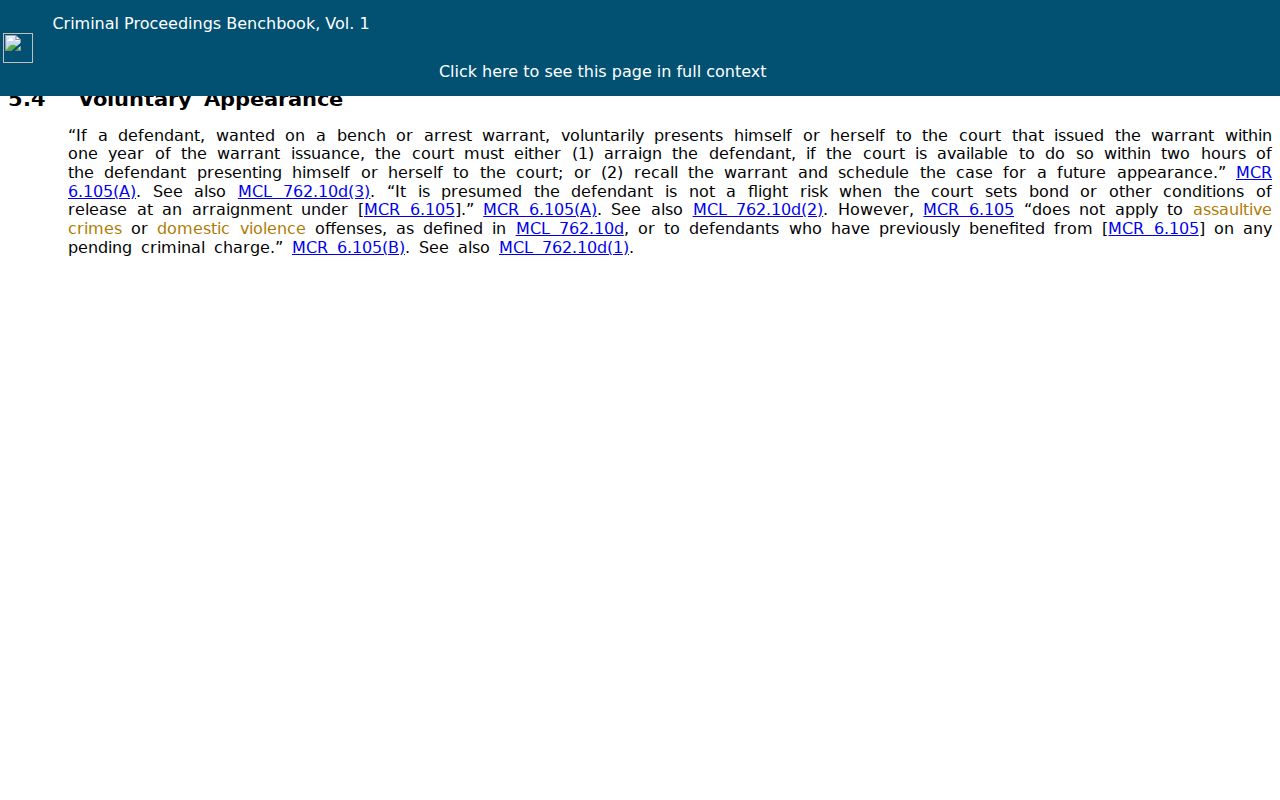
This excerpt of Michigan court rules describes an appearance route. It is no self-service warrant search. It cannot replace asking the issuing court about eligibility. Note: Confirm Michigan eligibility and the court's reporting process before going to the courthouse, since the rule has stated exceptions.
Michigan Bench Warrant Recall and LEIN Removal
Recall and record removal are two steps. A Michigan judge recalls the bench warrant first. The agency record comes off later. The statewide LEIN system is closed to the public, and only authorized users can check or update it. After a person appears or a judge grants a recall, what matters is the Michigan court's order and its communication with the serving agency.
| Michigan court action | The judge recalls or returns the warrant in the case record. |
|---|---|
| Michigan agency notice | The court contacts law enforcement after the appearance, using the local protocol. |
| Michigan LEIN status | The agency records removal and returns confirmation to the court when required. |
| Michigan public follow-up | Ask for confirmation of both the court entry and any agency notice or removal. |
Michigan form MC 220 shows the handoff in writing. It contains the court order, the agency-contact record, and the certificate of LEIN removal. Nobody files it alone to recall a warrant. Michigan also has no fixed statewide bond schedule, so confirm interim bail and payment terms with the issuing court.
Michigan Courts That Issue Bench Warrants
The issuing court calls the shots. It alone controls the bench warrant, bond, appearance, and recall. A sheriff or police agency may serve the paper, but it cannot replace the judge's decision on any of it. Read the court name on any notice or docket. Then use the Michigan county directory to reach local court and sheriff contacts. A felony bindover can move a case from district to circuit court. Ask which clerk holds the file now. For a Michigan city-ordinance matter, call the named city court directly. Do not assume a district-court portal or sheriff list covers it. For district, circuit, or probate cases, that clerk keeps the case record and can explain public inspection rules. Public Michigan court records follow MCR 8.119 plus local access orders. Michigan FOIA covers executive agencies, not court files. Agency requests never confirm a warrant's status. Bring the case number, ask which Michigan order remains open, and remember the directory only routes you; the issuing Michigan court gives the case-specific answer.